
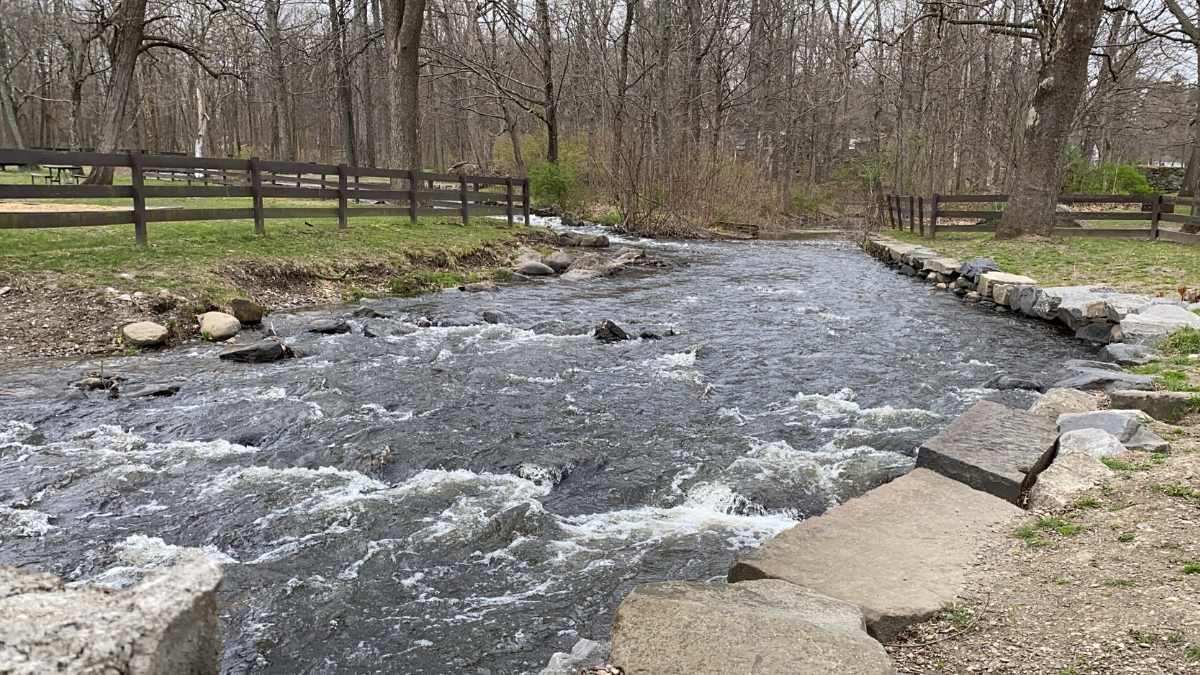
Algonquin Park is a free, 41-acre Orange County park in the Town of Newburgh, NY: easy trails, waterfalls, a fishing pond, a playground and the stone shells of a nineteenth-century gunpowder mill. It’s open from early April to mid-November. Below: the basics, our video walk-through, and the story of the mills.
At a glance
- Where: 54 Powdermill Road, Newburgh, NY 12550 (off Route 52), parking on site
- Open: early April to mid-November, weather permitting
- Cost: free to walk; the pond is free to fish (NY fishing license required)
- Good for: short family walks, the playground, picnics, fishing
- Not allowed: swimming, tents, bounce houses
- Picnic shelters: two, with electricity, by permit: (845) 615-3830
Watch the #VirtualAdventure
What the walk is like
Algonquin Park is an easy walk, not a hike. Wide gravel roads and footpaths run through the park, past the ponds and the stream, so you can do a short loop with small children or take your time and follow the water. Orange County lists nature trails, a playground, a pond area, fishing, two picnic shelters, a comfort station, benches, picnic tables, grills, and parking.
You will hear the falls before you reach them. The trails run close enough to the water that the park feels far deeper in the woods than it actually is.
The powder mill ruins
The stone buildings scattered through the park are not decorative. This was a working black-powder factory, and it is why the park is listed on the National Register of Historic Places as the Orange Mill Historic District — the only nineteenth-century gunpowder manufacturing site still standing in New York State.
The water here turned a sawmill first, Foster’s. Asa Taylor bought the mill privilege in 1816 and put up mills to make gunpowder. Daniel Rogers bought the property the following year, improved it, and converted the works into “over thirty substantial stone structures,” making powder here until 1838. Rogers’ sons ran the works after him, and by the 1880s they belonged to the Laflin & Rand Powder Company, which was still operating here in 1891. Production continued into the early twentieth century.
A history of Newburgh published in 1859 called them “the most complete and extensive works in the country.” Some of those thirty-plus stone buildings are what you are walking past.
Black powder was dangerous to make. The buildings sit spaced apart along the water for a reason: when one mill went up, the distance kept the blast from taking the rest of the complex with it. Walk the site with that in mind and the layout reads as what it is — a risk plan built in stone.
Getting there, hours, and cost
Address: 54 Powdermill Road, Newburgh, NY 12550, off Route 52.
Parking: on site.
Season: Orange County opens Algonquin Park in early April and closes it in mid-November, weather permitting. This is not a year-round park — check Orange County Parks before you drive out, especially at the edges of the season.
Cost: Free to visit and walk. Reserving a picnic shelter requires an advance permit and fee from the county, and fishing requires a New York State license.
Know before you go
- Seasonal, not year-round. Early April to mid-November. This is the most common way to waste a trip out here.
- The ruins are ruins. They are unrestored stone structures. Keep children close and stay out of the buildings.
- Wear real shoes. Gravel and packed dirt near moving water.
- Pack out what you bring in.
Questions people ask
Is Algonquin Park open now?
It’s seasonal: early April to mid-November, weather permitting. Check Orange County Parks before you go near either end of the season.
Is it in the City of Newburgh?
No. It’s in the Town of Newburgh and run by Orange County, about 4 miles (roughly a 10-minute drive) from downtown Newburgh.
Can you fish?
Yes, at no charge, from the banks or from a wheelchair-accessible landing. A New York State fishing license is required.
Can you swim?
No. Swimming isn’t allowed.
Can I reserve a picnic shelter?
Yes, by county permit with an advance fee. Call the Parks office at (845) 615-3830 or reserve online through Orange County Parks. For smaller gatherings (15 people or fewer), there are picnic tables and grills near the playground.
Why this park matters to the creek
Algonquin Park sits on the Quassaick Creek watershed — the same water that runs down through Newburgh to the Hudson. The Quassaick Creek Watershed Alliance has proposed a nature trail running from the Hudson River all the way up to Algonquin Park, the idea behind the Quassaick Creek Greenway. Standing at the powder mill, you are at the upstream end of it.
That is why this park turns up in Outdoor Promise’s work at all. The mills that built Newburgh — powder here, wire and paper and cloth downstream — all ran on this one creek, and the city’s environmental story runs along it too.
Walk the rest of that story with Newburgh’s Water: Flowing Through Time, or take the self-guided water tour on your phone.
Bring your family and get lost in the trails of history.
This post is also available in:
