
Ten Years After Washington Lake: Newburgh’s Water and a Cleanup Pushed to 2051
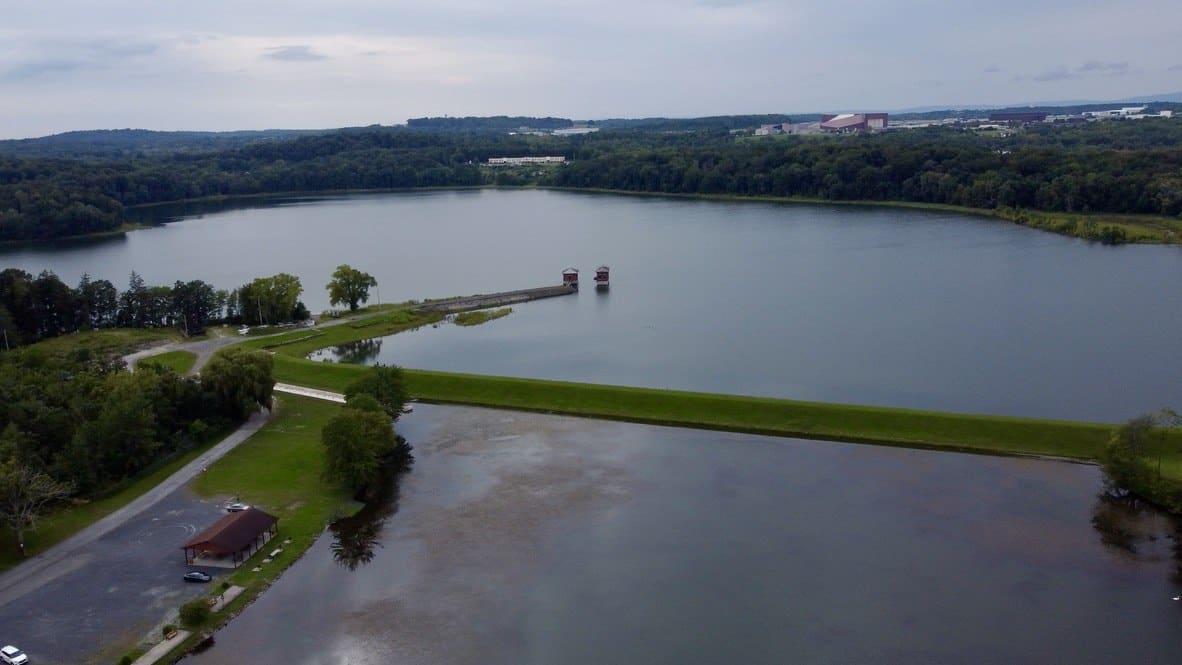
Ten years ago Newburgh lost its drinking water source. PFAS from firefighting foam used at Stewart Air National Guard Base had reached Washington Lake, the reservoir that served the city for more than 160 years. The federal study that decides how the base gets cleaned up was due this September. It is now scheduled for 2051.
This fall there were two gatherings about that date: a press conference at the lake on September 4, and an evening at the Newburgh Free Library on October 21 where residents could put questions to the people running the cleanup. We were at both. Here is what happened, what our partners said, and where to learn the full story of the water. For the background, start with our program page, Newburgh’s Water: Flowing Through Time.
What changed
The Department of Defense calls the next step a Remedial Investigation and Feasibility Study. It maps how far the contamination has spread and lays out the options for a permanent fix. The schedule said that work would be finished in September 2026.
The date moved twice this summer. In late July, reporting on the Pentagon’s own progress data showed that PFAS deadlines had been pushed back at more than 20 military sites in New York. Stewart’s new date was 2047. A few days before the September 4 press conference it moved again, to 2051, about 25 years late. Rep. Pat Ryan raised the first delay in an August 5 letter to the Secretary of Defense. The Defense Department has not answered reporters’ requests for comment.
The 2051 date covers the study, not everything at the base. Interim work continues: the stormwater filter at Recreation Pond, pipe repairs and new trenches. And the study is only the first step. The cleanup itself comes after it.
Members of the base’s Restoration Advisory Board, the citizen board that reviews the cleanup four times a year, told WAMC they met on July 22 and heard nothing about a new schedule. They read about it in the news four days later.
September 4 at Washington Lake
On September 4, advocates and local officials gathered on the shore of Washington Lake. We filmed the full press conference, about 27 minutes. The video description has chapters for each speaker.
Jennifer Rawlison of the Newburgh Clean Water Project co-chairs the Restoration Advisory Board. She spoke for the residents who have sat through ten years of meetings:
“For 10 years, the people of Newburgh have done everything asked of us. We have participated in health studies, attended public forums, answered surveys, and dedicated countless unpaid hours to the RAB process, trusting that the military would ultimately do right by us. Instead, the Department of Defense treats our lives as optional.”
Jeremy Cherson of Riverkeeper, which helped uncover the Washington Lake contamination in 2016, compared the timeline to the Hudson River cleanup:
“We first discovered the PCBs in the Hudson River in the 1940s and are still dealing with that legacy contamination today.”
Rob Hayes of Environmental Advocates NY explained the health side. PFAS are called forever chemicals because they stay in the environment for thousands of years. The EPA has found no known safe level of exposure to some of them. Researchers link them to thyroid disease, kidney and testicular cancer, and preeclampsia.
Rep. Pat Ryan, who convened the event, noted that a five-year-old in Newburgh today will be 30 before the study is finished. Assemblyman Jonathan Jacobson, Orange County Legislator Gabrielle Hill and the city’s representative on the Restoration Advisory Board also spoke. All of them asked people to come to the October 21 session.
What it means for your tap
Newburgh’s drinking water is safe today. The city’s 2025 Water Quality Report found no PFAS and no violations. That is because the city has been buying water from New York City’s Catskill Aqueduct since June 2016, and Washington Lake has not been used since. New York State listed the base as a State Superfund site in August 2016.
The water department pays about $120,000 a month for the raw aqueduct water. That does not include the replacement carbon for the filters that treat it. New York State reimburses the city two years at a time.
The interim measures have problems of their own. The filter at Recreation Pond was built in 2019 for dry-weather flows. Rawlison told WAMC it fails “usually 40 to 80% of the time.” In heavy rain, up to 1,800 gallons a minute can bypass it and flow toward Silver Stream and Moodna Creek.
October 21 at the library
On Wednesday, October 21, the Restoration Advisory Board held its annual poster session and quarterly meeting in the Board of Education room at the Newburgh Free Library. At the poster session, Air National Guard staff and their contractors stand next to maps and sampling results, and residents ask them questions directly. There is no three-minute limit.
The community groups set up their own tables, coordinated by Riverkeeper. The Quassaick Creek Watershed Alliance and Outdoor Promise had the first tables, with maps and images of the city’s creeks, lakes and watersheds. The Newburgh Clean Water Project brought its 3-D watershed model, which shows how the contamination traveled, and a second table with puppets, coloring books and ways to get involved. Jay Beaumont, a member of the advisory board, showed a model of the contamination in the Moodna Creek watershed. Riverkeeper ran a comic-making activity on the question “Is my drinking water safe to drink?” and shared calls to action on PFAS disclosure and drinking-water standards. We shared the water tour and gave out water bottles.
Lily Rubino of Bard College brought the research results and the artwork from Clean Water Community Day, the bilingual gathering at Placita La Amistad on September 19 where 75 residents shared their views on the water. Dorothy Lipsius’s installation, built from discarded plastic bottles, shows how many families rely on bottled water because they do not trust the tap. Rubino presented that community feedback to the military representatives that evening.
The Restoration Advisory Board meets four times a year, in English and Spanish, and the meetings are open to the public. The Newburgh Clean Water Project, Hudson River Sloop Clearwater and Riverkeeper post the dates, documents and recordings.
The water tour
The easiest way to understand this story is to follow the water. Newburgh’s Water: Flowing Through Time is a free, self-guided tour in English and Spanish. It has nine stops from the Hudson waterfront to Crystal Lake, about 11 miles by car or bike. The narration plays on your phone as you reach each stop: the creek that gave the city its first name, the mills and shipyards, Washington Lake, the filtration plant, and the people taking care of the water today.
- Take the tour on your phone: outdoorpromise.org/watertour
- Print the rider booklet: 24 pages with the route map, every stop and historic photos, in English or Spanish
- Bring a group: schools, churches and community groups can email us to ride the route together on the Adventure Bus
We built the tour with the Quassaick Creek Watershed Alliance, the Newburgh Clean Water Project, Riverkeeper and the City of Newburgh archives. The program page is Newburgh’s Water: Flowing Through Time.
How to get involved
- Come to the next Restoration Advisory Board meeting. Dates are posted by the Newburgh Clean Water Project, Hudson River Sloop Clearwater and Riverkeeper. You do not need to know anything about PFAS to attend.
- Join the groups doing the work. The Newburgh Clean Water Project has followed the Stewart cleanup since 2016. The Quassaick Creek Watershed Alliance meets monthly. Riverkeeper patrols the Hudson and its tributaries.
- Read the city’s Water Quality Report. It comes out every year.
- Take the tour and share it with a neighbor.
Sources
- Newburgh Times, Stewart Air Base PFAS Cleanup Pushed Back Decades. Come Ask Why on Oct. 21. (Sept 24, 2026)
- Rep. Pat Ryan, letter to the Secretary of Defense (Aug 5, 2026)
- WAMC, Newburgh parade to highlight 20-year delay of PFAS cleanup at Stewart Air National Guard Base (Aug 24, 2026) and RAB fears federal shutdown will delay PFAS cleanup (Oct 21, 2025)
- News 12, Outrage in Newburgh after PFAS cleanup at Stewart base delayed decades (Sept 4, 2026)
- City of Newburgh, 2025 Water Quality Report
- Outdoor Promise, Clean Water Community Day: From Harm to Healing in Newburgh (Sept 2026)
This post is also available in:
