

Stewart Cleanup Decision Now 2051: What Newburgh Heard at the Oct. 21 RAB Meeting
On Wednesday, October 21, the Stewart Air National Guard Base Restoration Advisory Board held its annual poster session and quarterly meeting in the Board of Education room at the Newburgh Free Library, 124 Grand St. For two hours, residents moved between the tables of the groups that have watched Newburgh’s water for a decade, the Guard and the city’s Water Department. Then, for one hour, the National Guard’s cleanup managers took questions on a schedule that now puts the final cleanup decision for the base in September 2051.
This is the record of that evening at the Stewart RAB meeting. The background, how PFAS from the base took Washington Lake out of service in 2016 and why the study date moved from this September to 2051, is in our October 30 piece, Ten Years After Washington Lake. The whole story of the city’s water, from the Hudson waterfront to Crystal Lake, is Newburgh’s Water: Flowing Through Time, our free bilingual tour.
A note on sources. Outdoor Promise tabled during the poster session and did not record the meeting that followed. The account of what the Guard and its contractor presented comes from the Mid Hudson Times report of October 28 by Niko Balkaran. When the board posts the slides, we will link them here.
Who was in the room
The poster session ran from 4:30 to 6:30 PM. Riverkeeper coordinated the community tables; the Air National Guard and the City of Newburgh Water Department had tables of their own.
- The Quassaick Creek Watershed Alliance brought a map of the watershed. The Alliance has played a pivotal role since the beginning of this issue, notifying the community about PFAS and keeping the creek in the conversation.
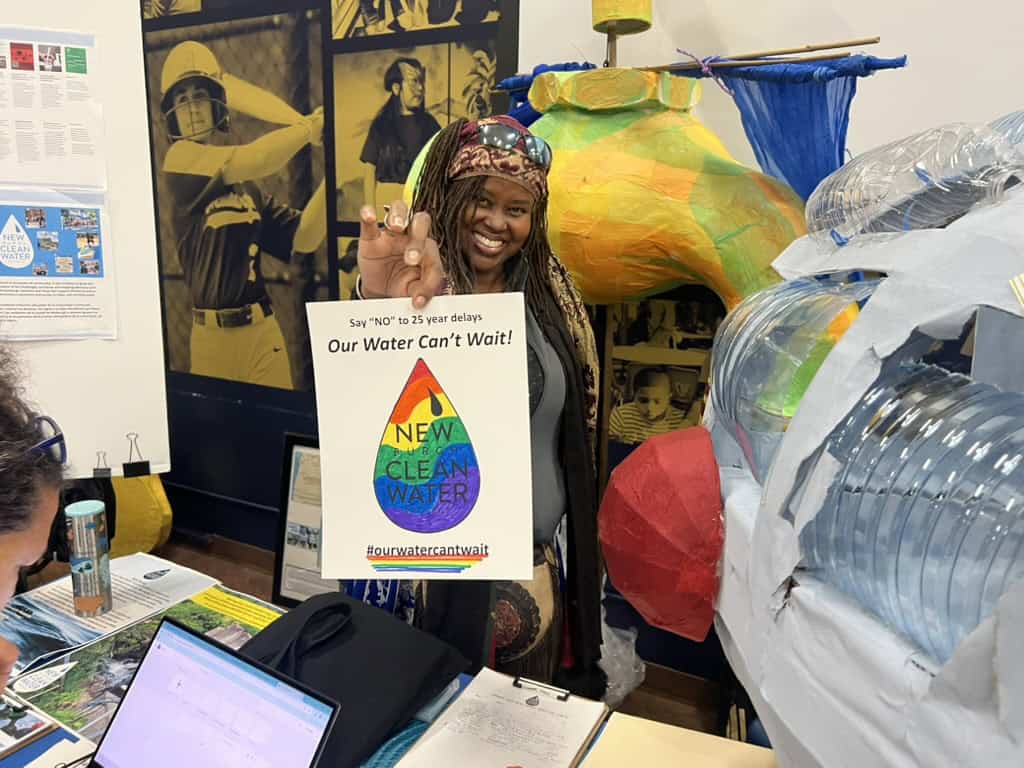
- The Newburgh Clean Water Project had bilingual handouts, “PFAS & Newburgh: What You Need to Know,” and the plastic-bottle installation from Clean Water Community Day, beside a sign that said what the group has said all fall: Our Water Can’t Wait.
- Jay Beaumont, a member of the Restoration Advisory Board, brought the 3-D model of the contamination, the clearest way in the room to see how PFAS moved off the base.
- Riverkeeper ran a comic-making table on one question: “Is my drinking water safe to drink?”
- Lily Rubino of Bard College brought the research results and the artwork from Clean Water Community Day, the bilingual gathering at Placita La Amistad on September 19 where 75 residents shared their views. The feedback collected that day was carried into the materials she shared with the military representatives in the room.
- Outdoor Promise shared Newburgh’s Water: Flowing Through Time, the free bilingual tour, with the route handouts and the rider booklets.

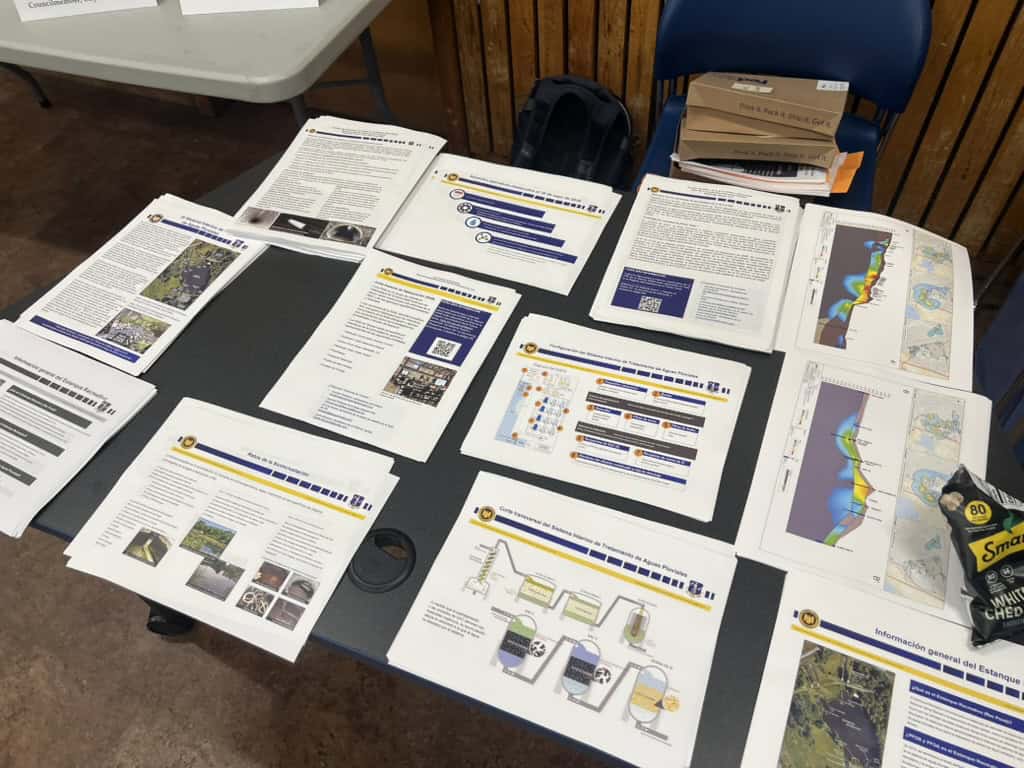
The City of Newburgh Water Department brought a wooden water main from around 1800, dug up on Grand Street, and a hydrant cutaway, and answered questions about the system that delivers the water today. The Guard’s table held Spanish-language handouts on the Recreation Pond interim treatment system, with site maps and a cross-section of the filters.
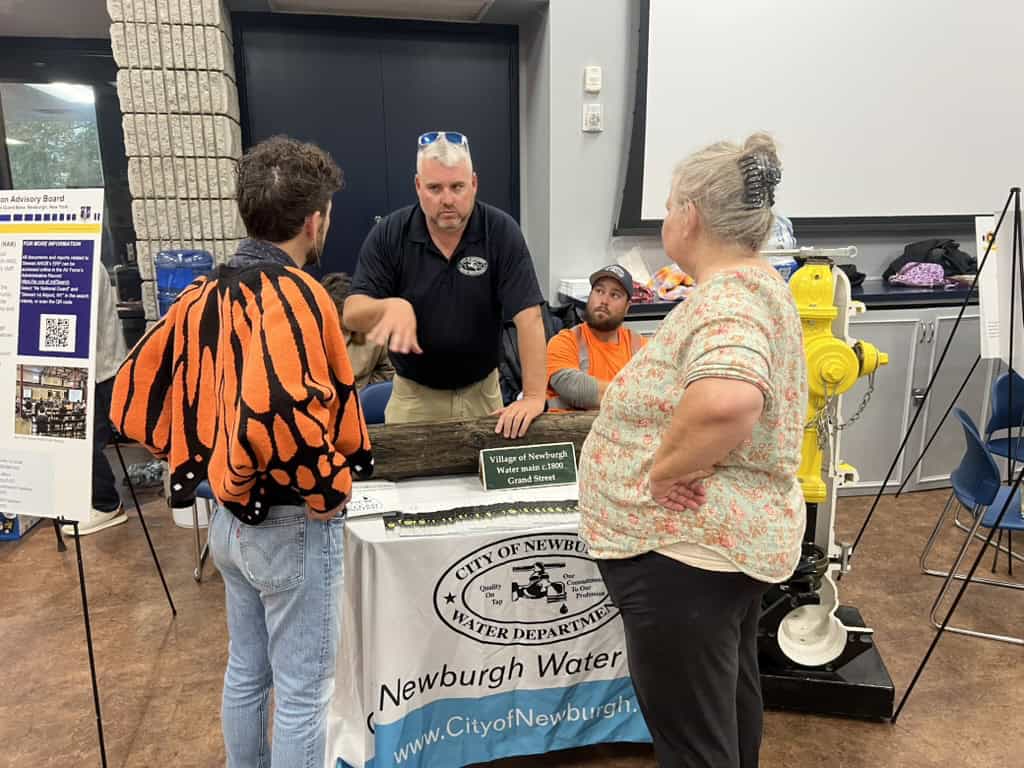
The board meeting began at 6:30 in the same room.
What the Guard said
The headline number was 2051. Bill Meyer, the National Guard Bureau’s restoration program manager for Stewart, said the September 2051 date refers to the final cleanup decision, not the completion of the cleanup. He attributed the schedule to additional environmental investigations, evaluation of possible cleanup methods, and uncertainty over federal funding. For comparison, an April 2023 presentation to the board had projected three to six years for the same study.
The pieces of that schedule, as reported:
- The current environmental investigation is targeted for completion by summer 2027.
- Additional studies after that could take another two to five years.
- Funding for those studies is not secured. Stewart competes with other military installations for federal restoration dollars.
On the interim measures, the work meant to slow the flow of PFAS off the base while the study runs:
- An additional $3.1 million brings the existing contract for groundwater and stormwater work to about $14 million. The work has not started because of property access and permitting issues.
- The planned work includes a trench along the base’s southern boundary to intercept contaminated groundwater, and repairs to three cracked underground drainage pipes.
- A proposal with the New York State Department of Transportation would redirect Route 17K stormwater away from Recreation Pond. It is estimated at about $2.6 million, split equally between the Air National Guard and the DOT. No formal agreement has been signed.
Doug Close of Bristol Environmental Solutions, which operates the interim treatment system at Recreation Pond, reported that the system was operational 96 percent of the time from July through September but treated only 42 percent of the water that passed through it. The system can process about 500 gallons per minute. Heavy storms can send as much as 100,000 gallons per minute into the pond.
What was said
Jennifer Rawlison of the Newburgh Clean Water Project, the board’s community co-chair, said board members learned of the revised schedule from news reports rather than from federal officials.
“I definitely know my kids will be older and they shouldn’t have to be fighting this fight.”
Assemblymember Jonathan Jacobson also addressed the meeting, urging a faster timeline.
What the numbers mean for your tap
Newburgh’s drinking water is safe today. Since June 2016 the city has drawn its water from New York City’s Catskill Aqueduct, and Washington Lake remains out of service. Nothing said on October 21 changes that.
What the numbers describe is the water that keeps moving off the base. The Recreation Pond system catches a share of it in dry weather and much less in a storm, and the trench and pipe repairs meant to catch more have not broken ground. Downstream of the pond are Silver Stream and Moodna Creek, and then the Hudson. The 2051 date is when the federal government expects to decide how the permanent fix will work. The fix itself comes after.
The documents
- Mid Hudson Times, Decades-long wait for Stewart Cleanup decision (Oct 28, 2026), the fullest public account of the meeting.
- Newburgh Times, Stewart Air Base PFAS Cleanup Pushed Back Decades. Come Ask Why on Oct. 21. (Sept 24, 2026), the preview.
- Restoration Advisory Board documents and recordings are posted by the Newburgh Clean Water Project, Hudson River Sloop Clearwater and Riverkeeper.
- Outdoor Promise, Ten Years After Washington Lake: Newburgh’s Water and a Cleanup Pushed to 2051 (Oct 30, 2026) and Clean Water Community Day: From Harm to Healing in Newburgh (Sept 2026).
Photos: Outdoor Promise, Newburgh Free Library, October 21, 2026.
What’s next
- The next Restoration Advisory Board meeting is set for January 2027. The date and place will be posted by the Newburgh Clean Water Project, Clearwater and Riverkeeper. Meetings are open to the public and interpreted in Spanish.
- Join the people doing the work. The Newburgh Clean Water Project has followed the Stewart cleanup since 2016. The Quassaick Creek Watershed Alliance meets monthly. Riverkeeper patrols the Hudson and its tributaries.
- Learn the story where it happened. Newburgh’s Water: Flowing Through Time is free, self-guided and bilingual: nine stops, about 11 miles, with the narration playing on your phone as you arrive. Print the English or Spanish rider booklet, or email us to bring a group on the Adventure Bus.
This post is also available in:
